Initial PLN – The Starting Point
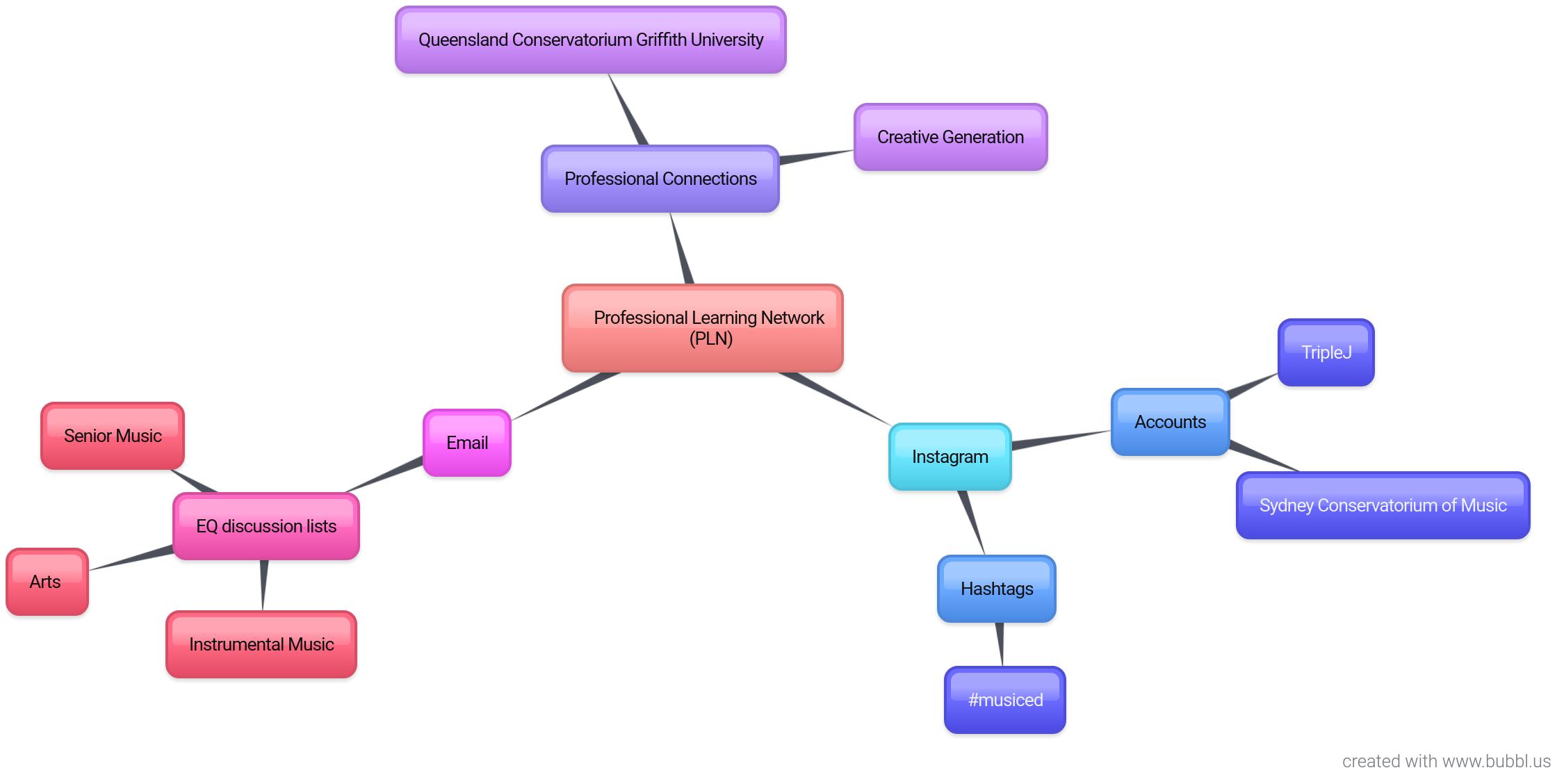
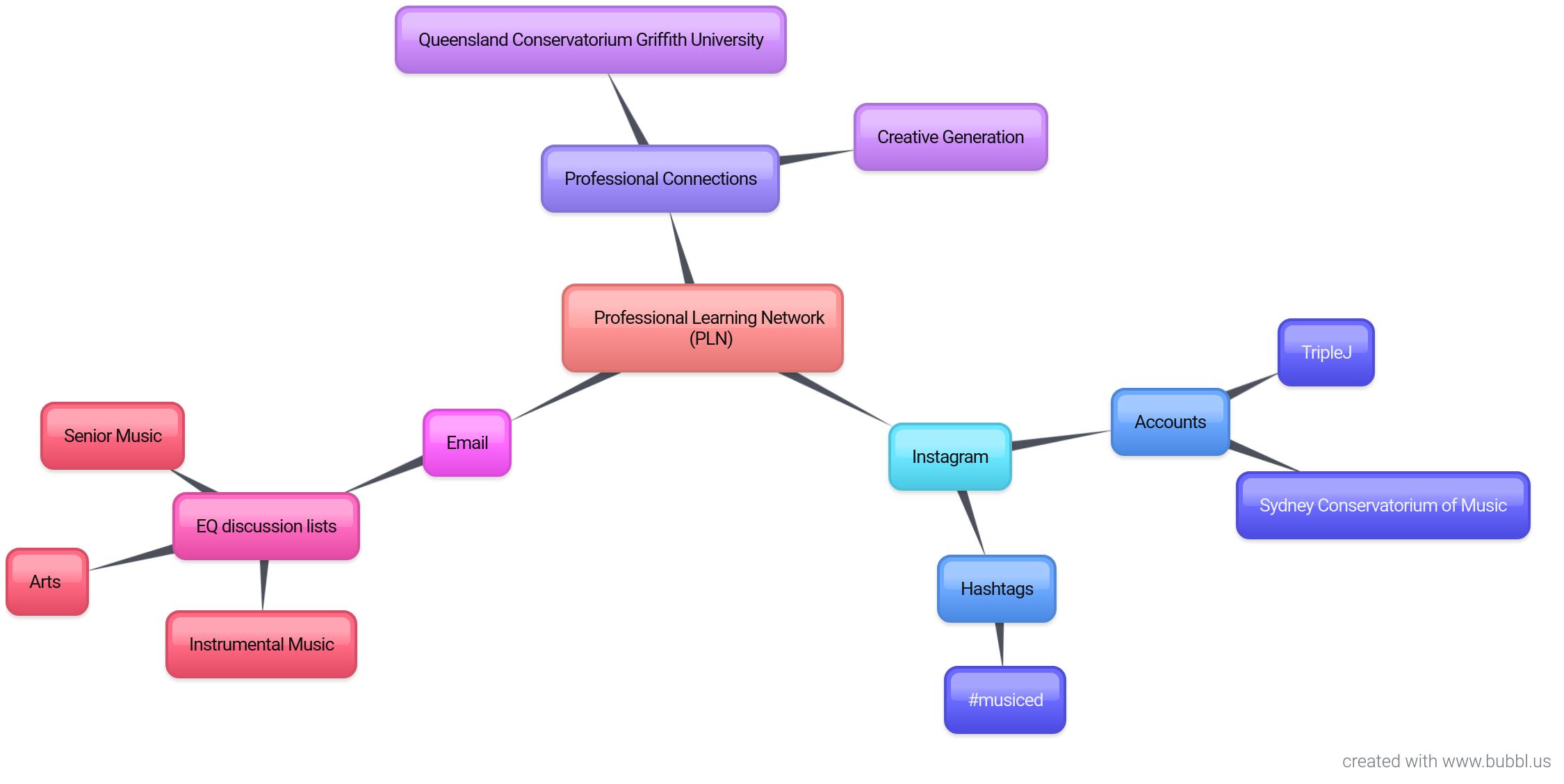
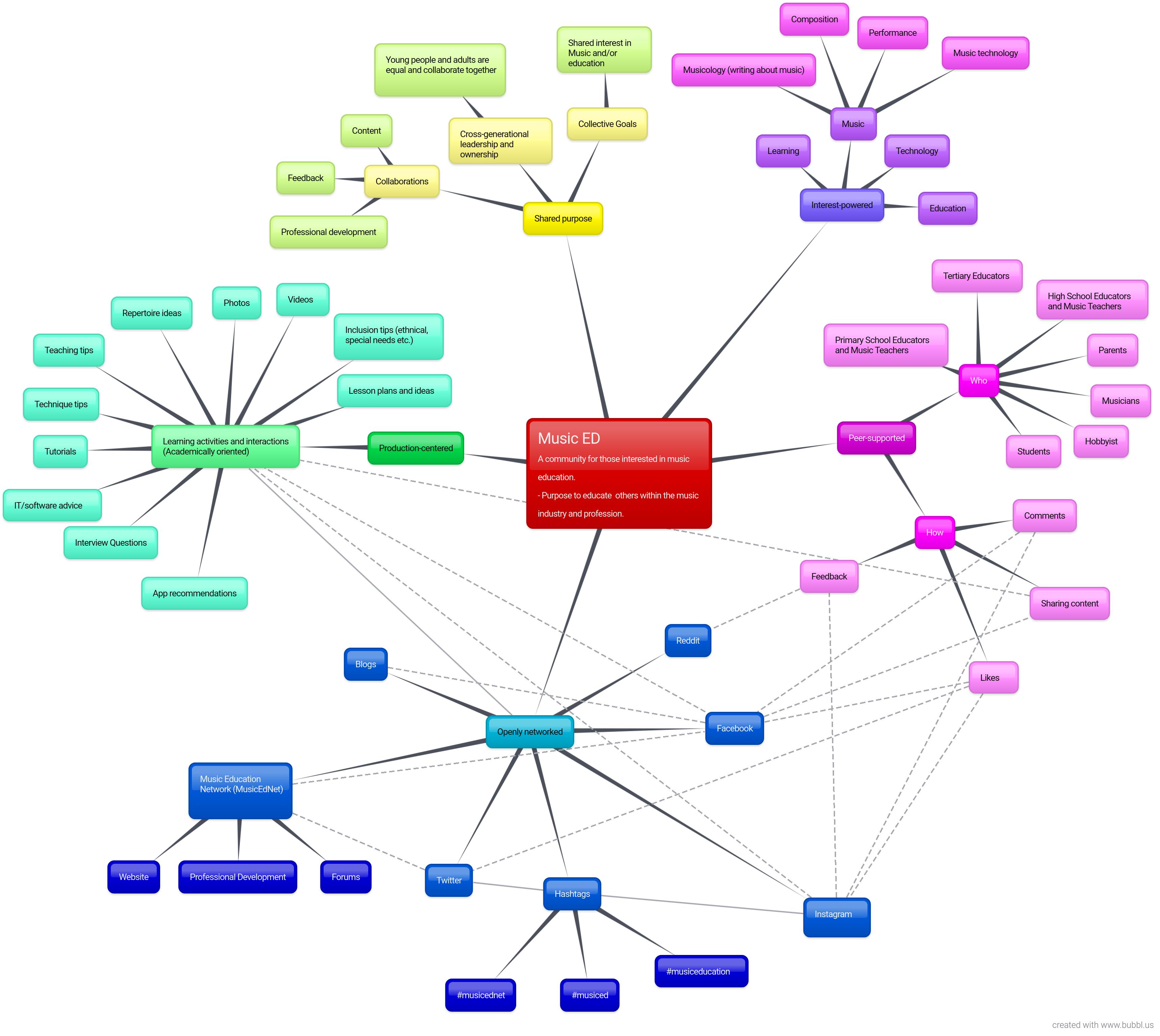
Professional Learning Networks (PLN) “can be understood as learning systems built upon an architecture of participation that can come to exist with or without specific objectives” (Carpenter, Krutka, & Trust, 2016b, p. 17). A PLN has the ability to allow teachers and instructors to be part of an equal sharing and learning platform; this can break down the traditional hierarchy found in some learning environments (Carfagna, 2014). The broad focus within my PLN is Music Teaching; with the specific focus of improving my teaching practice, classroom activities and curriculum development. In early 2019 my PLN was mapped to outline the connections within my network. As seen in the image below there are very few social media accounts, hashtags and external connections within the network.
The Music Teaching network is quite active. Many teachers are sharing via hashtags on various social media platforms. There are many worthwhile hashtags and accounts to follow. On Twitter the #MusicEd hashtag has on average 40+ tweets daily. Instagram has a similar figure of daily posts via #MusicEd. While the Facebook group (Queensland 2019 Senior Music/Music Extension Syllabus Teachers) only has an average of 2-5 posts daily. These consist of posts from professionals, teachers and other education providers whose activity on social media also assist in my PLN.
Within this blog, my PLN will be mapped, analysed and reflected on in order to see how my PLN has developed through the introduction of social media and active participation.
“Individual agents engage in these systems through various forms of participation – from committed engagement to more peripheral lurking – that are generally transactional in nature. In other words, as people participate in a system, they change it, and the system changes them. The responsive nature of PLNs might offer teachers access to interactions and resources necessary to grow professionally”
Carpenter, Krutka, & Trust, 2016b, p. 17
Developing My PLN
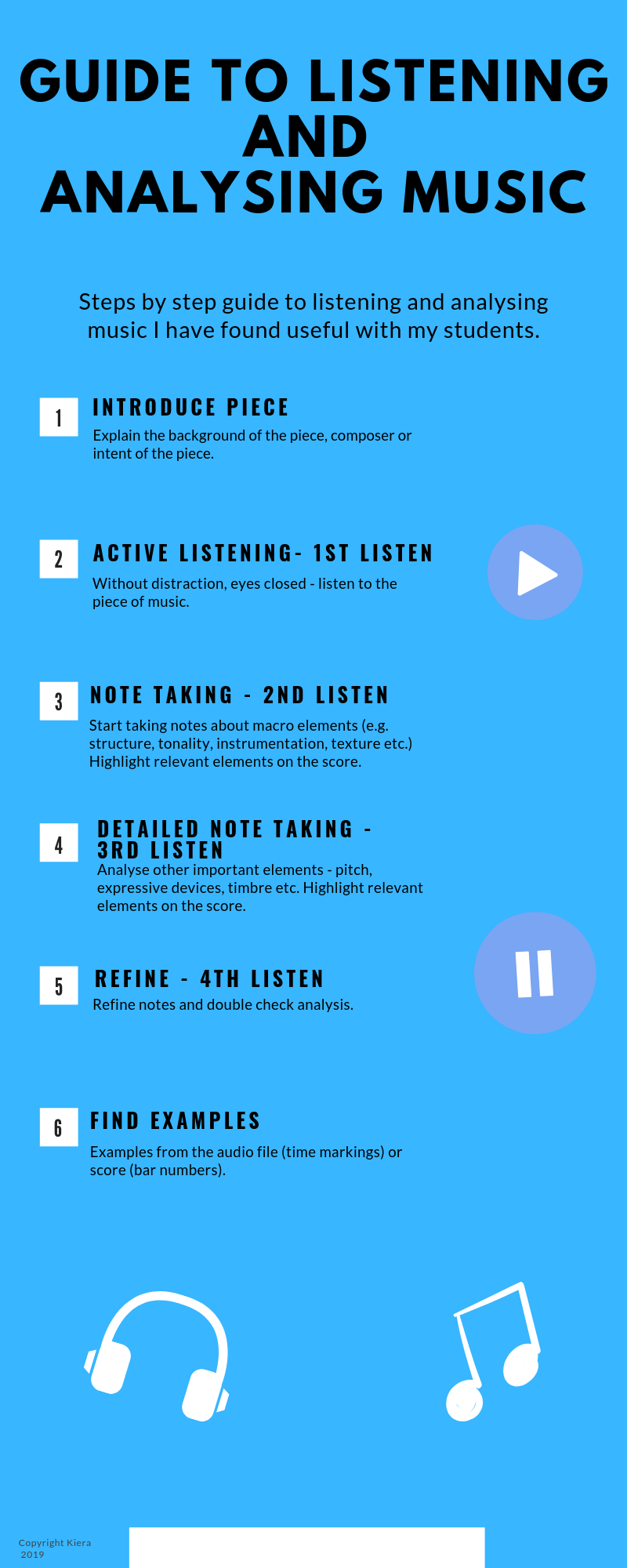
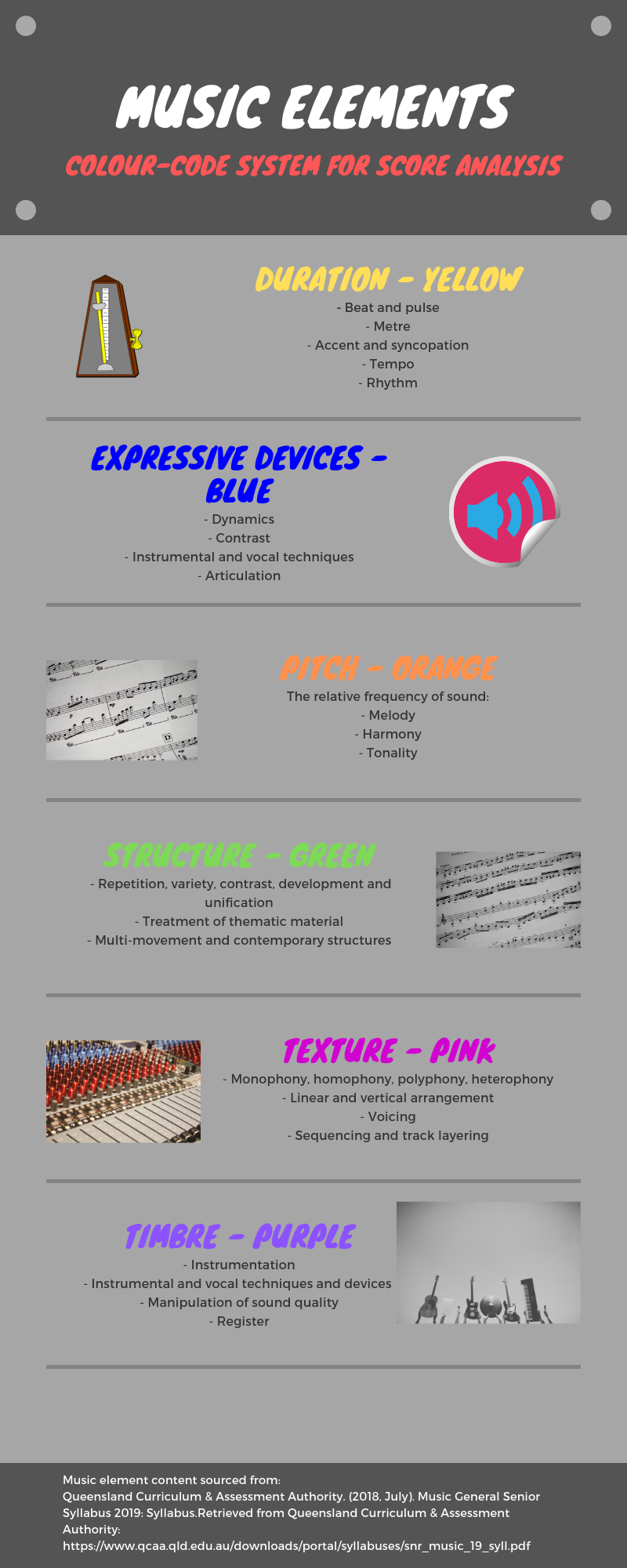
As it can be seen in my initial PLN map, there weren’t many connections in February 2019. Before this unit of study I was collaborating and contributing within my limited network, which mainly consisting of teachers within my school context or close teacher friends. I would rarely like, comment, share or post content about Music Teaching. Since studying this unit, I have been able to experience first-hand the benefits of a PLN. The contributions I have made to my PLN can be found here. The first contribution was an infographic about the steps in analysing music for students. The purpose of this was to share what is working with my students and hope that others would find it useful. “PLNs provide educators with greater access to the classroom-informed and tested ideas of peers” (Carpenter, Krutka, & Trust, 2016a p. 155). The second contribution was a blog post outlining how my teaching has changed and developed over the last few months after the introduction of the new Senior Syllabus in Queensland. Within this post I shared a key or legend which was introduced to the senior students in order to assist their music analysis tasks. In sharing my experiences about the new syllabus with other teachers, I was able to feel “… a sense of companionship in the face of demanding tasks and learning challenges” (Wenger, 2011). If others know they are not alone it might assist in their teaching and classroom activities.
Linking, stretching and amplifying are terms which outline the learning experiences and key characteristics a connected professional will transition through (Oddone, 2019b). Oddone (2019b) defines these three experiences as:
- Linking is associated with problem-solving particular professional learning needs within a short term or immediate timeframe.
- Stretching involves extending the individuals learning through the network through discovery or curiosity.
- Amplifying is associated with the creation, sharing, distributing and collaboration of resources and information within the network.
The artefacts shared within my network would be considered linking as they were targeting specific issues. As I am still building my network, there were limited opportunities for amplifying and stretching. These will come with time.
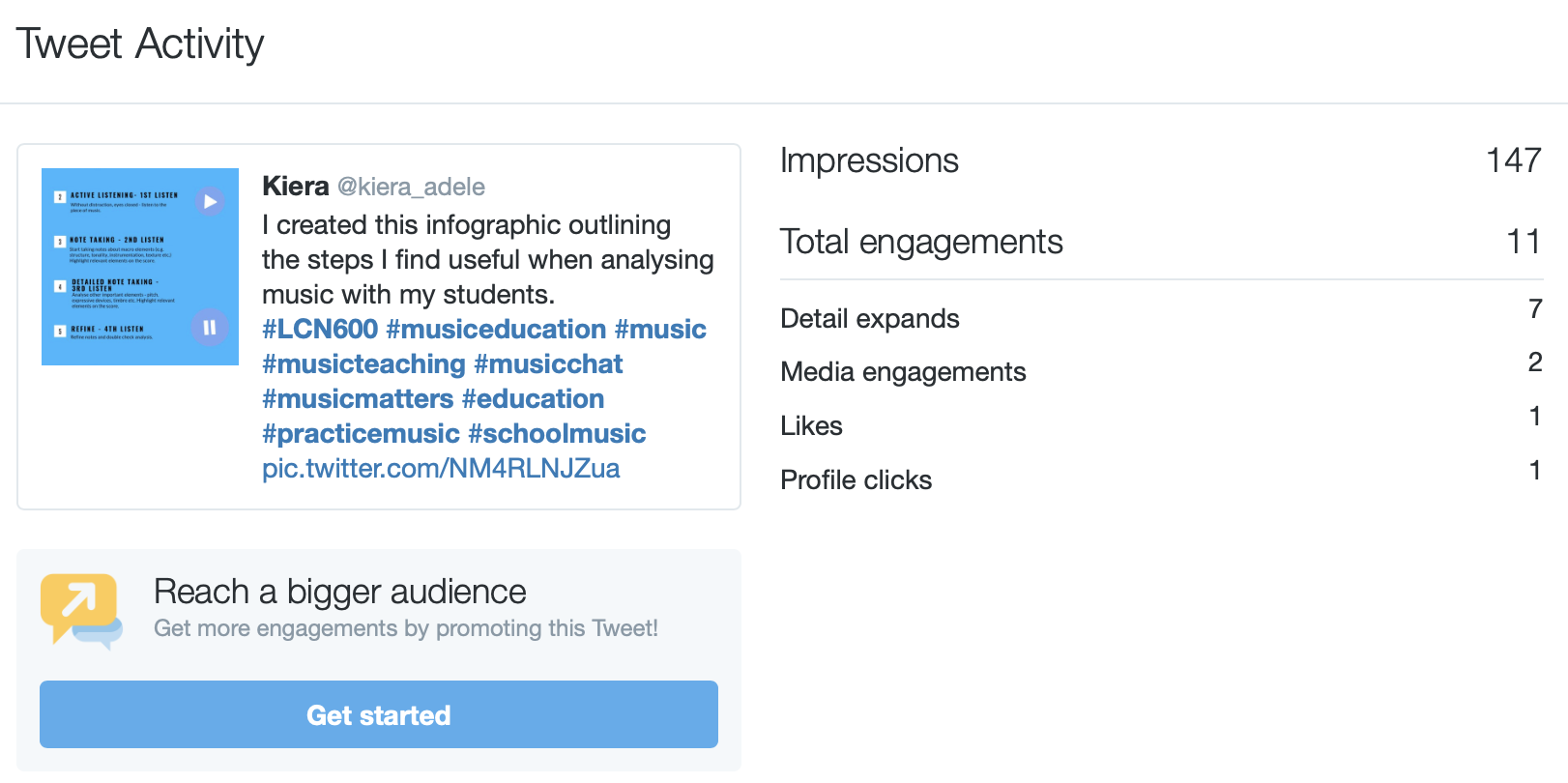
It was reflected upon as to why the artefacts that were presented had limited interactions from my PLN. The first infographic was intended to help others who are teaching aural and visual music analysis. I have tried this model within my classes, and it has proved to work, increase engagement and build their subject knowledge. The students have made the process a habit now. There was a great number of impressions for this post but only one like – the break down of the activity can be seen below. Through the Twitter hashtags used in the posts, I was able to reach a bigger audience, both within Australia and potentially internationally.
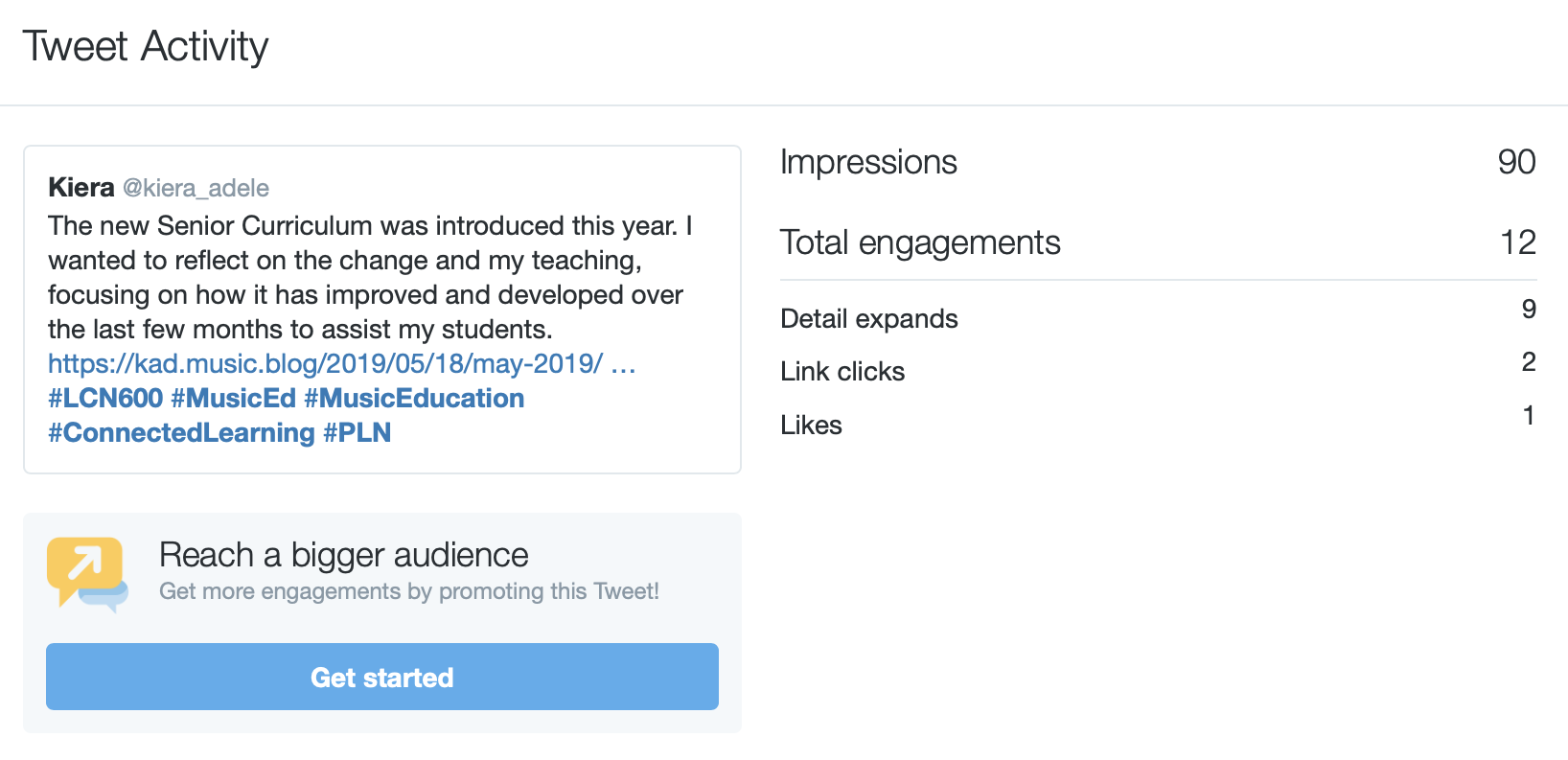
The second artefact was a blog post and imbedded infographic about the new Senior Syllabus which received some engagement and views via Twitter – see the image below for the detailed activity. Within the post I explain how I have gone back to basics within my lessons. This can be difficult but a reminder of easy ways to break down tasks can be helpful. The lack of engagement from the extended network on both posts is considered a critical incident.
Engaging with accounts and other people through the social media platforms has not increased followers or likes on either post. It could be possible that people are lurking and finding the post beneficial without commenting or liking. Participation can vary from observing or lurking within the PLN to actively participating (Carpenter, Krutka, & Trust, 2016b).
Contributing resources to the PLN via the hashtags has helped form knowledge capital. Wenger (2011) outlines that knowledge capital can be produced in many ways these being personal assets (human capital); relationships and connections (social capital); resources (tangible capital); collective intangible assets (reputational capital; Transformed ability to learn (learning capital). Resources or tangible capital is where a community or network is given access to resources from members. This type of sharing has been evident within the closed Facebook group Queensland 2019 Senior Music/Music Extension Syllabus Teachers. Members within this group have been sharing documents, resources and repertoire lists all contributing to the knowledge capital through resources. The artefacts I shared within my network were resources teachers could use within their classrooms with students. Using the scale on the Transformative Teacher Developmental Framework by Baker-Doyle (2017), my PLN activity would sit between emerging and participatory. Within the two categories of ‘knowledge construction’ and ‘relationship development’ the activity within my PLN is more advanced than technical and not at the leader phase at this point in time. There will be an opportunity for my participation to move to leader over time.
Through developing my PLN I have been able to expand the breadth of hashtags in which I follow via the TweetDeck, accounts and persons of interest, and groups to be involved in. A detailed map showing where my PLN is now can be seen below.

Reflection and Outcomes
Through developing my PLN I have found many areas of interest. I have been able to focus on senior curriculum development, instrumental teaching and classroom activities just to name a few. There are many avenues in which it is easy to branch off to, it is easy to get lost at times! Branching out and finding new accounts to follow and engage with has helped my PLN development. I have been able to confirm queries I have had within my teaching through finding the content in my PLN. The Facebook group Queensland 2019 Senior Music/Music Extension Syllabus Teachers has really helped with reaffirming some concerns or questions I have had. Within the closed group, teachers are sharing resources, asking questions and sharing repertoire for current or upcoming units. I have found this beneficial within my PLN and development of my teaching. It is reassuring to know that others are out there finding the new syllabus challenging and that I am not alone. I have found comfort in this and have therefore been confident in my teaching and planning. “Just hearing someone else’s story can open one’s imagination or reveal a new perspective. And being with others who understand one’s challenge can be a relief” (Wenger, 2011, p. 22).
I have found some great accounts and groups to follow. The accounts and hashtags can be seen on my PLN Map. The previously mentioned Facebook page has been a great insight into what fellow teachers are doing. Following #MusicEd via the TweetDeck has brought many other insights. I have been able to share and engage with accounts and posts from companies and professionals. An example of this engagement can be found on Twitter and below.

Through developing my PLN I have found that social media has a lot to offer. Being able to connect with people who I would not normally have the opportunity to meet or see at professional development has been and will be beneficial well into the future. Through my PLN, my digital footprint has grown from my involvement in February 2019 (as seen in the initial PLN map) through to developing my current and ever-growing PLN. I have explored and actively participated in multiple social media platforms. My social network identity on Twitter is professional and I only share tweets that are related to my work or professional interests. Contrasting to Facebook and Instagram which are more personal network identities. Only a few groups or hashtags are being followed through these accounts. My digital literacy has developed during the expansion of my PLN. I have enjoyed sharing content and exploring what others are doing within the Music Teaching Profession. There are many skills that have been refined for example consumption and sharing of content; creating and sharing of content; development, expression & management of a range of digital identities across platforms (Oddone, 2019a). These skills have allowed me to become more confident with sharing professional content online.
Developing my PLN has allowed for growth and development in many areas. Personally, I have been able to grow my professional learning connections and resources. I have also been able to refine the skills and ability to share valuable content with others. All of this while connecting with professionals and/or teachers I would not normally be connected with throughout the school year. My PLN will continue to grow, develop and change over time. There are always changes with teaching and staying across these is important to me. Wanting to be the best teacher I can will always shape my PLN with smaller foci taking the priority occasionally. The many interests of classroom, music technology and instrumental teaching are all included within my future PLN. The final PLN map can be found here.








 MusicED